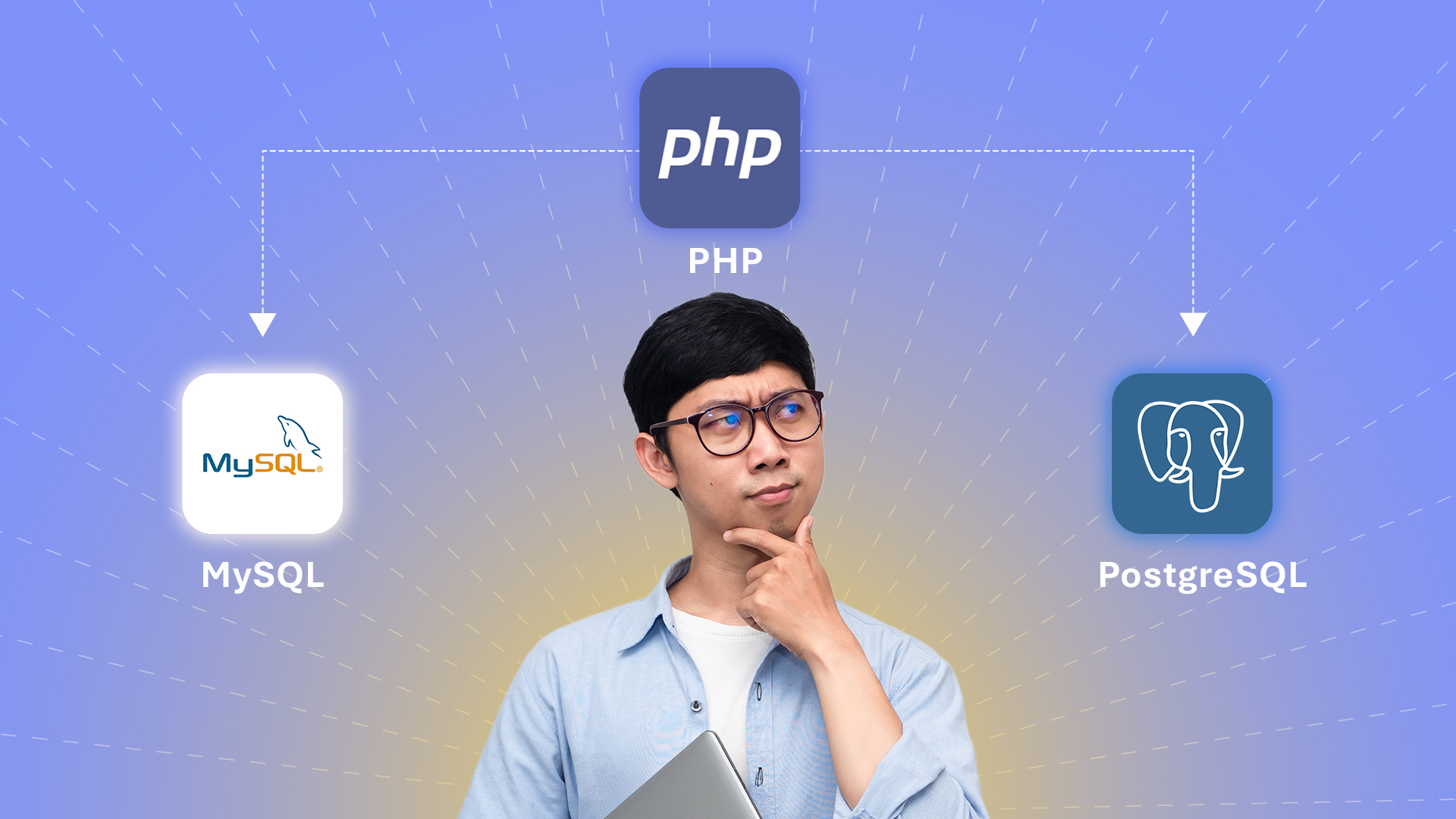
The digital landscape of 2026 has fundamentally rewritten the rulebook for selecting a persistence layer. For over two decades, the LAMP stack (Linux, Apache, MySQL, PHP) was the undisputed blueprint for web development. MySQL was the “comfortable” choice—fast for reads, ubiquitous, and simple. But as modern applications evolve in complexity and scale, more teams are beginning to Choose PostgreSQL Over MySQL to meet advanced data, performance, and reliability demands.
But as enterprise requirements shift toward agentic AI integration, complex data governance, and high-concurrency bespoke software, that “default MySQL” mindset is becoming a technical liability. At ClinkIT Solutions, we’ve seen a decisive architectural pivot: PostgreSQL is the strategic priority for the next generation of PHP applications.
The Foundation of Divergence: Process Models and Resource Isolation
The most fundamental split between these two giants lies in how they handle work. It’s the difference between a shared office and private, soundproofed studios.
PostgreSQL: The Process-Per-Connection Model
PostgreSQL is an Object-Relational Database Management System (ORDBMS) that employs a process-per-connection model. When your PHP application talks to Postgres, the database forks a new operating system process for that session.
Each process consumes approximately $10 \text{ MB}$ of memory. While that sounds “heavier” than a thread, it provides fault isolation. If one process hits a rare edge-case bug or memory corruption, the rest of the cluster stays rock-solid. For enterprise-grade apps where uptime is the only metric that matters, this isolation is a massive insurance policy.
MySQL: The Thread-Per-Connection Model
MySQL (via InnoDB) uses a thread-per-connection model. Threads are lightweight and share memory space. This allows MySQL to handle thousands of idle connections with very little overhead—perfect for lightweight CMSs or standard blogs. However, shared memory means that a failure in one thread can, in rare cases, destabilize the entire process.
The 2026 Reality: Connection Management
In the PHP world of stateless request-response cycles, connection overhead is a constant battle. While MySQL handles native connections better, modern PostgreSQL deployments solve this with tools like PgBouncer or Supavisor. These multiplex thousands of app connections into a small pool of persistent database connections, giving you the best of both worlds: process-level stability with thread-like efficiency.
| Feature | PostgreSQL (ORDBMS) | MySQL (RDBMS) |
| Connection Model | Process-per-connection | Thread-per-connection |
| Memory Isolation | High (Individual OS processes) | Moderate (Shared process space) |
| Isolation Level Default | Read Committed | Repeatable Read |
| Storage Architecture | Heap-based (MVCC) | Clustered B-tree (Undo Log) |
Data Integrity: The “Transactional DDL” Game Changer
If you’ve ever had a database migration fail halfway through on a production server, you know the cold sweat that follows.
PostgreSQL supports Transactional DDL (Data Definition Language). This means schema changes—adding columns, changing types, or creating indexes—can be wrapped in a transaction. If the migration fails, the database rolls back to its original state.
In MySQL, DDL operations are generally not atomic. If a migration crashes, you might end up in a “half-migrated” state, requiring manual (and risky) surgical intervention to fix the schema. For ClinkIT Solutions’ clients in FinTech and healthcare, that risk is simply unacceptable.
Expert Tip: PostgreSQL is also a “strict” teacher. It will reject a string being shoved into an integer column, whereas older MySQL versions were notorious for “silent type conversions.” Postgres ensures your data layer remains the single source of truth, so your PHP code doesn’t have to play detective.
Semi-Structured Data: JSON vs. JSONB Excellence
In 2026, we rarely deal with purely relational data. We need flexibility for evolving APIs and dynamic metadata. While both databases support JSON, their implementations are worlds apart.
PostgreSQL’s JSONB (Binary JSON) is the industry gold standard. Unlike standard JSON (which stores raw text), JSONB stores data in a decomposed binary format.
- GIN Indexes: You can create Generalized Inverted Indexes on JSONB columns, allowing sub-millisecond lookups inside deep, nested structures.
- Containment Operators: Using operators like @> or ? makes querying JSON feel like a native feature rather than an afterthought.
2026 Performance Benchmarks
Recent benchmarks show that for complex extractions, PostgreSQL’s JSONB is significantly faster than MySQL’s implementation.
| Operation | PostgreSQL (JSONB) | MySQL (JSON) | Improvement |
| Simple Extraction | $150 \text{ ms}$ | $600 \text{ ms}$ | $75.0\%$ faster (PG) |
| Containment Query | Native GIN support | Virtual Column Index | Superior (PG) |
| Update Efficiency | Entire object rewrite | In-place binary update | Win (MySQL) |
The “Postgres Everything” Ecosystem
Perhaps the strongest argument for the pivot is the extension ecosystem. The “Postgres Everything” movement suggests that instead of managing a fleet of specialized databases, one Postgres instance can do it all with ACID guarantees.
- pgvector: Essential for 2026 AI workflows. It allows PHP developers to store and query vector embeddings for RAG (Retrieval-Augmented Generation) directly in the database.
- PostGIS: The undisputed heavyweight champion of geospatial data.
- TimescaleDB: Transforms Postgres into a high-performance time-series database for IoT or audit logs.
By using these extensions, a team can start with a simple CRUD app and evolve into an AI-driven platform without the massive cost of migrating to new database engines.
Performance in the Modern Context
The old myth that “MySQL is faster” is largely dead. While MySQL 9.x is still a beast at simple primary key lookups, PostgreSQL 17 and 18 have introduced Parallel Query execution and Asynchronous I/O (AIO).
PostgreSQL can now utilize multiple CPU cores for a single query. This is a game-changer for heavy reporting or complex data-crunching tasks. When we integrate Power BI with PHP backends, we rely on this parallelism to ensure executive dashboards load in milliseconds.
Strategic Decision Matrix: When to Make the Move
While MySQL remains a solid choice for straightforward CRUD applications and traditional CMS platforms, certain “red flags” suggest it’s time to pivot to PostgreSQL:
- Analytical Lag: Your reporting queries are slowing down the whole app.
- JSON Bottlenecks: You’re doing heavy filtering on dynamic metadata.
- AI Ambitions: You need to store vector embeddings for semantic search.
- Strict Governance: You require Row-Level Security (RLS) for multi-tenant SaaS.
Conclusion: Investing in Technical Excellence
In 2026, database selection is a business decision, not just a coding preference. PostgreSQL offers the robust foundation required for modern bespoke software—especially as AI and semi-structured data become central to the brand story.
By collaborating with a Microsoft Solutions Integrator like ClinkIT Solutions, businesses can navigate these architectural crossroads with confidence. Whether you are building from scratch or looking to modernize a legacy stack, the shift to PostgreSQL is a strategic investment in long-term scalability and market competitiveness.
Let’s build smarter campaigns together. Reach out to our team today.
Whether you’re starting from scratch or optimizing what you already have, we’ll help you turn great ideas into powerful, high-performing digital experiences.
Clink With Us!