Picking the wrong tech stack isn’t just a headache for your engineering team anymore—it is a direct threat to your bottom line. A poor architectural choice quickly translates into eye-watering cloud bills, hiring bottlenecks, and technical debt that stalls growth for years.
Monolithic legacy setups and sluggish interfaces drop user engagement and tank SEO rankings, especially now that search engines demand instant, genuinely helpful content that addresses real-world business challenges.
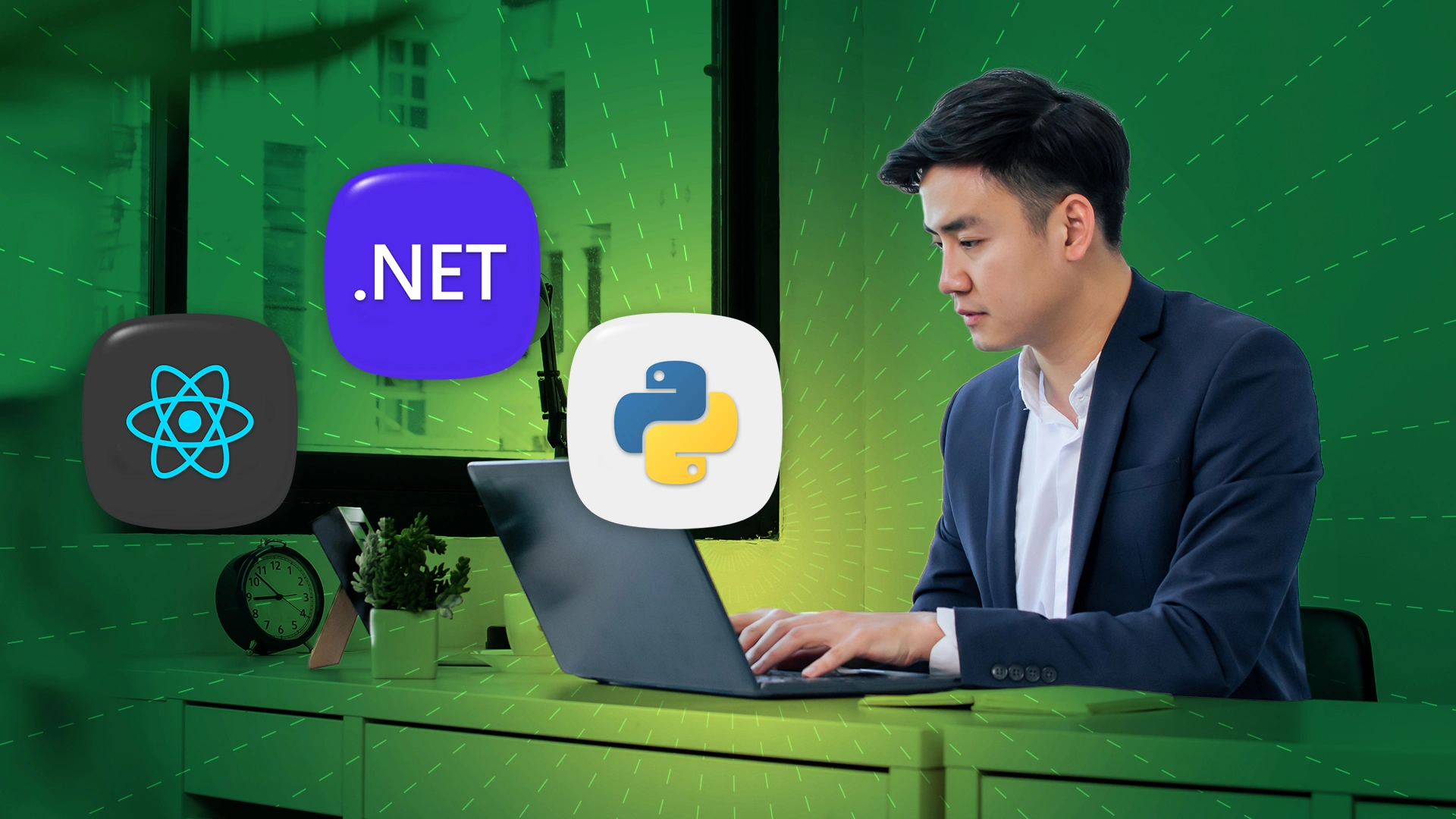
The fix isn’t finding a single “magic bullet” language. It is about building a smart, polyglot framework. By anchoring your core transactions with the security of .NET, running heavy-duty data engineering and AI through Python, and delivering a crisp user experience with React, you get a future-proof setup that scales. Partnering with specialized engineering teams like ClinkIT Solutions ensures these technical choices map directly to your actual business goals.
.NET 10: The Enterprise Core
For mid-sized and global businesses, unexpected downtime is incredibly costly. If you are in healthcare, finance, or logistics, an outage means lost revenue and compliance headaches. .NET has always been the safe choice here, but the .NET 10 Framework changes the game for infrastructure costs.
The big shift is Native Ahead-of-Time (AOT) compilation becoming the standard default for web APIs and microservices. Instead of waiting for a Just-In-Time (JIT) compiler at runtime, Native AOT compiles code directly to machine instructions. This completely wipes out cold-start latency, cuts container memory usage by more than half, and shrinks image sizes.
If you are running thousands of pods across AWS, Azure, or Tencent Cloud, this means you can pack way more services onto fewer virtual machines, slashing your monthly cloud spend while maintaining instant auto-scaling.
Key Performance and Security Upgrades:
- Faster Asset Delivery: The new MapStaticAssets feature compresses static payloads by up to 92%, optimizing bandwidth and reducing user bounce rates.
- Caching Resilience: The HybridCache library provides unified caching across memory-bound and distributed Redis configurations, preventing database crashes during sudden traffic surges.
- Quantum-Ready Security: Includes post-quantum cryptography (PQC) support through Windows CNG APIs—introducing algorithms like ML-DSA and ML-KEM—to protect sensitive data against future decryption threats.
Python and FastAPI: The AI and Data Engine
If .NET handles the heavy lifting for transactions, Python runs the brains of the operation—data science, machine learning, and automation. But old-school synchronous Python frameworks like Flask fall flat under heavy concurrent traffic. That is why FastAPI Documentation has taken over, offering asynchronous speed on par with Go or Node.js.
Using standard Python type hints and Pydantic for validation, FastAPI speeds up feature development by 2x to 3x and cuts down on runtime bugs by nearly 40%. It lets you wrap complex AI models into clean, scalable microservices.
Real-World Applications:
- Fraud Prevention: Financial platforms use automated machine learning models (like XGBoost) to spot sketchy transactions in real time, bumping fraud detection accuracy by up to 30%.
- Supply Chain Optimization: Retailers using the Prophet library for time-series forecasting improve inventory tracking by 20% to 25%, preventing costly stockouts.
- Customer Retention: Running NLP via spaCy or NLTK for real-time sentiment analysis on reviews consistently boosts customer satisfaction and retention.
To keep operations compliant and fair, teams use tools like Fairlearn to catch algorithmic bias, while keeping these workloads isolated on the backend so sensitive API keys never leak to client devices.
React 19: Driving the User Experience
A rock-solid backend matters, but a lagging interface will still kill your conversion rates and drive up cart abandonment. React 19 tackles this by shrinking client-side bundle sizes and fixing the rendering lifecycle.
Instead of developers spending hours writing manual optimization hooks (like useMemo and useCallback) to stop unnecessary re-renders, the new automated React Compiler handles it all at compile time.
Even better, React Server Components (RSC) change how dynamic data loads. By running components strictly on the server, you avoid dumping massive JavaScript payloads onto the user’s browser. It drops your Largest Contentful Paint (LCP) time significantly, making pages feel completely instantaneous.
For fast actions like checkouts, Server Actions and the useOptimistic hook let the UI update in under 50 milliseconds while the actual transaction processes securely in the background. If the server rejects the update due to a validation conflict, the UI gracefully rolls back to its original state and provides a clear, localized error message.
Polyglot Integration via .NET Aspire 13
Mixing C#, Python, and React gives you the best of all worlds, but managing local service discovery, messy SSL certificates, and split logging across different languages used to be an operational nightmare.
.NET Aspire 13 fixes this by acting as a code-first orchestrator. With a single .NET AppHost project, you can run C# APIs, Python FastAPI instances, Node.js React setups, and your databases without touching a single hand-coded Docker Compose script.
Aspire injects service discovery directly into your environment variables, handles automatic SSL trust between languages, and tracks everything through OpenTelemetry standards. You can debug the entire distributed system from a single web dashboard. This strategy works exceptionally well when connecting older legacy databases with modern cloud tools—ensuring fast, responsive apps even under tight launch timelines.
Bridging Custom Code and Low-Code
Sometimes you need internal operational tools fast, and you can’t wait for a full bespoke build. That is where a hybrid architecture makes sense: mixing low-code speed with hard-coded backend stability.
Take Microsoft Power Apps. Business analysts can drag and drop a functional internal canvas app in days. To keep that app from becoming an isolated data silo, developers use .NET to build secure Web APIs that connect the low-code front-end directly to core SQL databases, ERP systems, and cloud infrastructure. Pair that with Power BI for real-time reporting via secure data gateways, and you get rapid deployment without sacrificing data control or performance.
Strategic Recommendations for Leadership
Your choice comes down to your system’s core purpose, not fleeting tech trends:
- For SaaS Products: Pair .NET 10 and React 19. It gives you the perfect mix of rapid UI iteration, fast server-side rendering, and cost-effective scaling for millions of users.
- For Heavy Regulation (Banking/Healthcare): Pair .NET 10 and Angular 21. Angular’s highly structured, opinionated environment ensures strict architectural compliance and rigid governance across massive engineering teams.
- For Data Intelligence: Isolate your predictive modeling and NLP workloads inside a dedicated Python FastAPI microservice linked to your core .NET API gateway via YARP or decoupled messaging queues.
- For Orchestration: Stop wasting time on manual scripting and adopt .NET Aspire 13 to standardize service discovery and telemetry across the board.
Building a tech infrastructure shouldn’t involve guesswork or bloat. If you are looking to audit your current backend architecture, scale up your predictive analytics, or launch a fast web platform, partnering with an agile team can clear the hurdles. The engineering specialists at ClinkIT Solutions provide bespoke software development and integrated cloud engineering designed to streamline execution. Reach out to their team to map out a future-proof technical roadmap for your business.
Let’s build smarter campaigns together. Reach out to our team today.
Whether you’re starting from scratch or optimizing what you already have, we’ll help you turn great ideas into powerful, high-performing digital experiences.