We’ve officially passed the tipping point. In 2026, the line between a traditional business and a technology company hasn’t just blurred, it has evaporated entirely. If you are building Software-as-a-Service (SaaS)
, you need a Tech Stack That Scales with Your SaaS, as your technology is no longer just a set of tools your engineers use. It is the central nervous system of your brand. It dictates your ability to pivot when the market shifts, determines your operational margins, and defines the customer experience.
Choosing this foundation is no longer a decision that should happen in an IT vacuum; it is a core strategic business imperative.
However, scalability in 2026 means something different than it did a few years ago. It’s not just about handling a surge in user traffic. True scalability now encompasses developer velocity (how fast can you ship?), operational cost-efficiency, and the ability to integrate advanced AI models without ripping down your entire architecture.
The Feature Fallacy, the idea that more functions equal more value,is dead. Instead, the most successful SaaS entities are prioritizing Operational Durability: system stability, clean user experiences, and a lean stack that performs high on a budget.
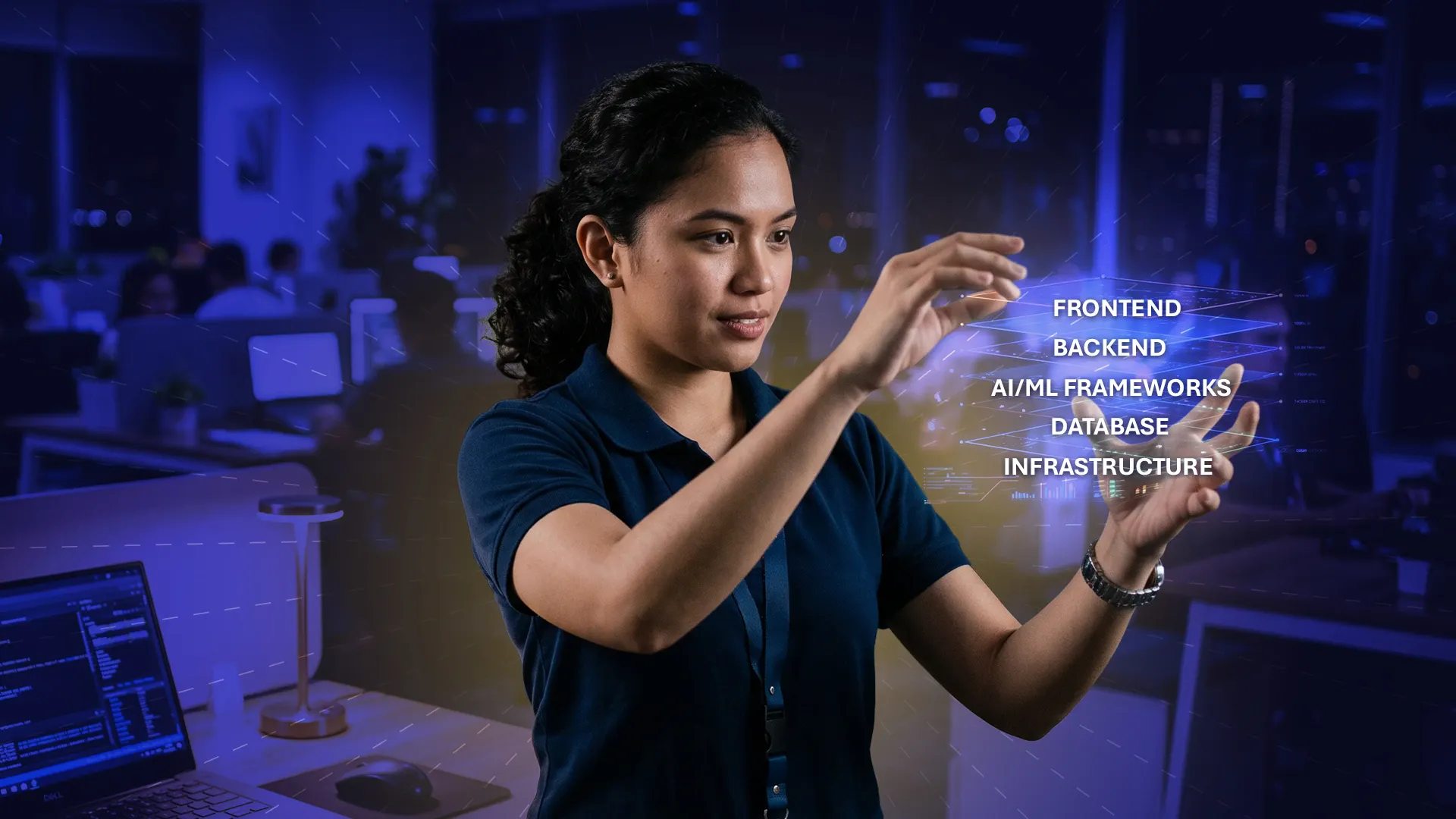
Here is an exhaustive, research-backed blueprint for selecting a technology stack that ensures long-term viability and scalability in the current landscape.
The Foundation: Why Full-Stack TypeScript is No Longer Negotiable
If you are looking for the safest bet for long-term scalability, look to TypeScript
. In 2026, it has cemented its place as the undisputed leader in SaaS development, boasting millions of active contributors on GitHub.
Why the dominance? It comes down to predictability and communication. By maintaining a single source of truth for data structures, teams can share types between the frontend, API routes, and database schemas. This catches bugs at compile time, long before they hit production, drastically reducing the cognitive load on your developers.
Furthermore, in an era where nearly every developer utilizes AI coding tools, TypeScript shines. Large Language Models (LLMs) generate significantly higher-quality code when they have strict type annotations to work with. The types provide the necessary context for the AI to understand the programmer’s intent, creating a virtuous cycle of faster development and fewer errors.
From a hiring perspective, TypeScript is now the default. Choosing a language with a niche talent pool is a massive risk; the TypeScript ecosystem guarantees a robust pipeline of talent and a wealth of support libraries.
Frontend Evolution: Prioritizing the Need for Speed
The frontend is where your brand’s story meets the user. Expectations for performance have never been higher; even a one-second delay in load time can significantly bruise your conversion rates.
To meet these demands, your stack must prioritize lightning-quick responsiveness.
- Next.js (The Enterprise Default): Holding roughly two-thirds of the market share for new React projects, Next.js remains the dominant force. With features like Partial Prerendering (PPR), it allows for hybrid pages where a static shell is served instantly while dynamic content streams in. This is critical for data-heavy SaaS dashboards.
- Remix (The Challenger): Now converged with React Router, Remix excels in data handling and edge-first architectures. It often delivers superior Time to First Byte (TTFB) and is a strong contender for data-intensive applications.
- Astro: If you are building content-heavy sites or marketing pages where performance is absolute king, Astro’s islands architecture (rendering zero JavaScript by default) is a powerful option.
The Data Layer: PostgreSQL as the Multi-Modal Powerhouse
Your database is the most critical architectural decision you will make regarding long-term scalability. While the allure of specialized databases is strong, PostgreSQL has solidified its position as the #1 choice for professional developers.
The shift away from older standards like MySQL is driven by Postgres’s sheer robustness. It handles complex relational data flawlessly, but its true power in 2026 lies in its extensibility. With extensions like pgvector, PostgreSQL functions as a vector database, enabling AI features like Retrieval-Augmented Generation (RAG) without requiring a separate, disconnected data store.
Consolidating your data layer simplifies your architecture and ensures that security features, such as Row Level Security (RLS), are applied consistently across all data types. Before you chase horizontal sharding or expensive hardware upgrades to solve performance bottlenecks, engineering teams in 2026 are prioritizing query optimization and indexing using tools like EXPLAIN ANALYZE.
Backend Logic: Matching Runtime to Use Case
While Node.js continues to lead in general developer adoption due to its synergy with TypeScript, we are seeing a strategic surge in performance-critical runtimes like Go and Rust for specific components.
- Go (Golang): The champion of cloud-native infrastructure. Its built-in concurrency model (goroutines) makes it exceptionally powerful for API gateways, microservices, and environments where CPU efficiency is essential.
- Rust: No longer experimental; Rust is the choice for systems where downtime or vulnerabilities are unacceptable. It offers execution speeds close to C++ but guarantees memory safety. If you are building fintech transaction engines or encryption services, Rust’s strict ownership model is worth the steep learning curve. It is also incredibly energy-efficient, helping to lower cloud bills.
Infrastructure: Lean, Serverless, and the Edge
Infrastructure is no longer a background utility; it is a driver of bottom-line efficiency.
The Lean Tech Stack philosophy encourages startups to utilize managed services (like Vercel or Supabase) to run an entire MVP for practically nothing, scaling costs only as revenue grows. This allows teams to obsess over building features, not managing server hardware.
Furthermore, as we look toward the bandwidth promises of 6G, Edge computing is complementing cloud architecture by distributing processing closer to the user. This reduces latency for real-time engagement (essential for AR/VR or IoT-driven SaaS) and lowers bandwidth costs by processing data locally.
Strategic Visibility: GEO and pSEO
A scalable stack must support a scalable growth strategy. In 2026, that means moving beyond traditional SEO into Generative Engine Optimization (GEO).
You are no longer just trying to rank on page one of Google; you are trying to be the source that AI models like ChatGPT and Perplexity cite when answering user prompts. To do this, your technical architecture must prioritize:
- Information Gain: Providing unique, verifiable data points that LLMs can use.
- Structured Data: Comprehensive Schema markup helps AI crawlers understand your authority.
- Programmatic SEO (pSEO): This is the primary method for scaling organic reach without scaling headcount. By generating large volumes of unique, high-quality landing pages based on templates, you can target thousands of low-volume, high-intent keywords that match specific customer pain points.
Common Pitfalls: Why Architectures Fail
Choosing the wrong stack early is a mistake that often goes unrecognized until it’s too late, potentially increasing time spent on fixes by $40\%$ as the product matures. Here are the traps to avoid:
- The Trend Trap: Do not select a framework based on industry buzz. If it lacks community support or documentation, it becomes a massive liability when you need to debug production issues.
- Overengineering the MVP: Founders often burn budget building complex microservices before they have validated the product. Start with a Modular Monolith and decompose it only when real performance bottlenecks emerge.
- Assuming Security Can Wait: A single data breach can permanently damage a brand. Build with security-first principles (encrypted storage, secure auth) from day one.
Conclusion
Choosing a tech stack that scales in 2026 is a balancing act. It requires leveraging the Lean Tech Stack for rapid validation while establishing an Enterprise Backbone (anchored in TypeScript and PostgreSQL) for long-term stability.
Successful scaling requires a holistic view that integrates technology choices with digital marketing and CX strategies. The mantra for modern SaaS founders is clear: start simple, plan for growth, and obsess over time-to-value.
Cheers to success.
Let’s build smarter campaigns together. Reach out to our team today.
Whether you’re starting from scratch or optimizing what you already have, we’ll help you turn great ideas into powerful, high-performing digital experiences.