Artificial intelligence is moving beyond isolated experiments and becoming part of everyday business operations. But adopting AI successfully requires more than choosing a model or purchasing an AI platform.
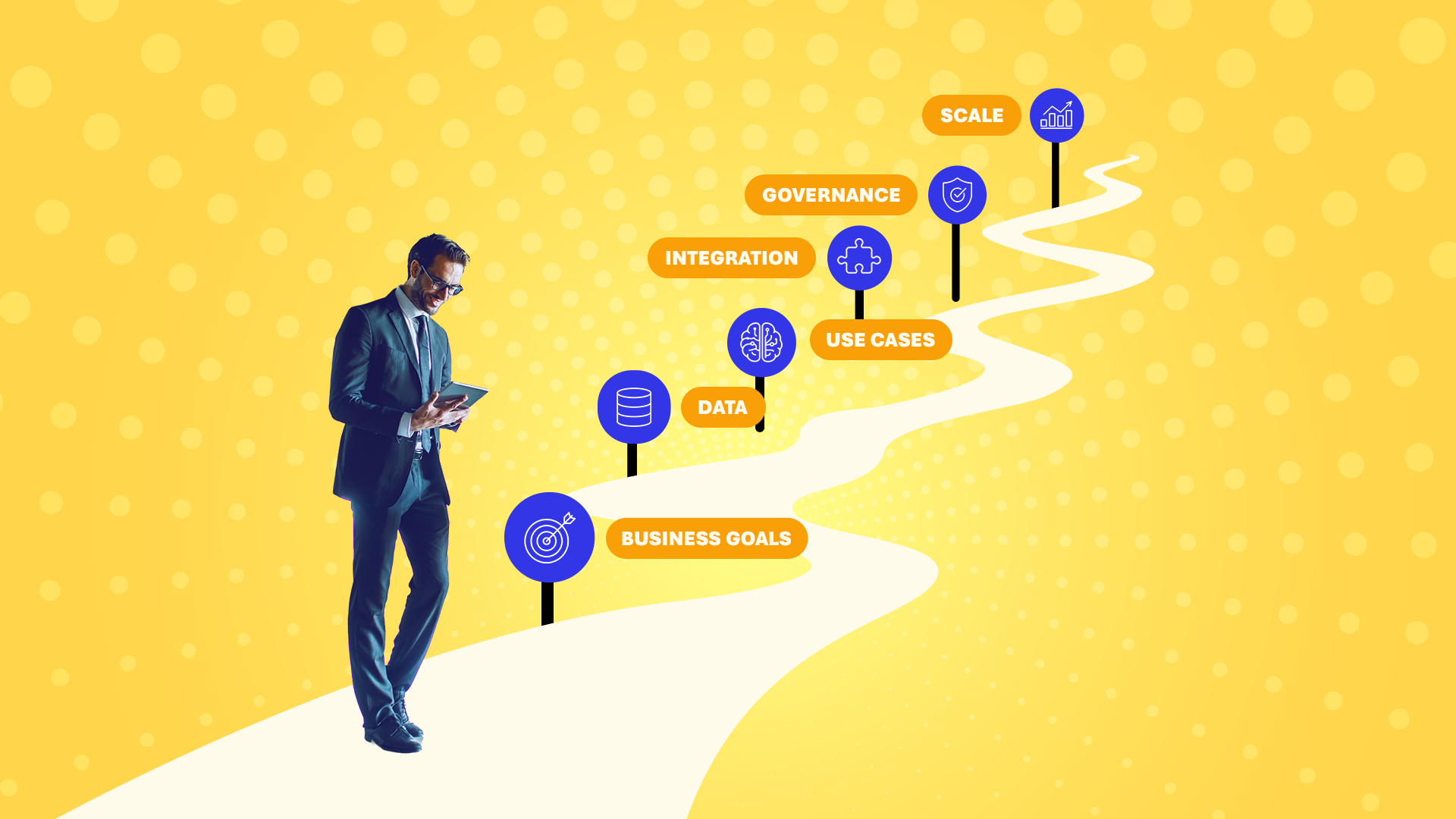
Businesses need reliable data, clearly defined use cases, secure infrastructure, governance, integration with existing systems, and measurable business outcomes.
For organizations in the Philippines, an effective AI strategy should also consider available technical resources, cloud architecture, data governance, cybersecurity, operating costs, and how AI will integrate with existing business applications.
In this guide, ClinkIT Solutions outlines a practical approach businesses can use to move from AI experimentation toward secure and scalable implementation.
The Real Shifts Happening Right Now
Companies succeeding with AI have tossed out the 2024 playbook:
From prompts to workflows: Instead of asking an assistant to write an email, businesses orchestrate multi-agent setups. These agents read tickets, fetch customer history via APIs, adjust ERP records, and run actions without a human copying text across screens.
From massive models to small engines: Firing up a multi-billion-parameter frontier model for a routine invoice is burning cash. High-performing engineering teams route structured, repetitive chores to 1B-to-8B parameter Small Language Models (SLMs). These run locally or at the edge, saving up to 80% on inference while keeping sensitive files strictly inside company firewalls.
From static files to hybrid retrieval: Dropping raw documents into a vector database causes hallucinations. Durable systems run real-time hybrid retrieval—merging traditional keyword indexing with dense vector spaces and semantic rerankers.
Building an AI Strategy for Philippine Businesses
Philippine organizations do not need to automate every process at once.
A practical AI strategy starts by identifying repetitive or information-heavy processes where automation can produce a measurable benefit while keeping risk manageable.
Potential starting points include:
- Customer support assistance
- Document search and knowledge retrieval
- Internal knowledge assistants
- Invoice and document processing
- Sales and customer-service workflows
- Data classification
- Report generation
- Software development assistance
Before implementation, organizations should determine where their data is stored, who should have access to it, which systems the AI application must connect to, and what actions require human approval.
Starting with a controlled business use case makes it easier to evaluate accuracy, cost, security, and return on investment before expanding AI across the organization.
The Tactical 5-Stage Blueprint
To scale without throwing capital into a black hole, move through clear, gated checkpoints:
Fix data hygiene: Clean legacy document stores, define standardized metadata schemas, and enforce role-based access control down to individual text chunks. If the data is messy, your agents will merely automate bad judgment.
Sort by reversibility: Start with high-impact, high-reversibility tasks—like support ticket drafts or accounts payable reconciliation where humans provide final sign-off. Save autonomous financial transactions or medical determinations for later.
Lock down enterprise cloud rails: Keep proprietary models, vector weights, and prompts walled off inside dedicated enterprise tenants, such as Microsoft Azure, so customer data never trains public models.
Hardcode guardrails: Treat governance as engineering. Use programmatic firewalls to kill prompt-injection attempts, strip personally identifiable info, and monitor real-time token drift.
Enforce 90-day sprints: Spend 30 days mapping APIs, 30 days prototyping the retrieval pipeline, and 30 days running real transactions in a single business unit. If it doesn’t reduce cost-per-task, kill it.
Bridging this gap takes seasoned engineering. Backed by two decades of systems integration and recognized as a Multi-Gold Certified Microsoft Partner holding Solutions Partner designations in Data & AI as well as Digital & App Innovation, ClinkIT Solutions builds the resilient Azure architectures, custom agent workflows, and governance engines that turn fragile experiments into durable balance-sheet wins.
Let’s build smarter campaigns together. Reach out to our team today.
Whether you’re starting from scratch or optimizing what you already have, we’ll help you turn great ideas into powerful, high-performing digital experiences.