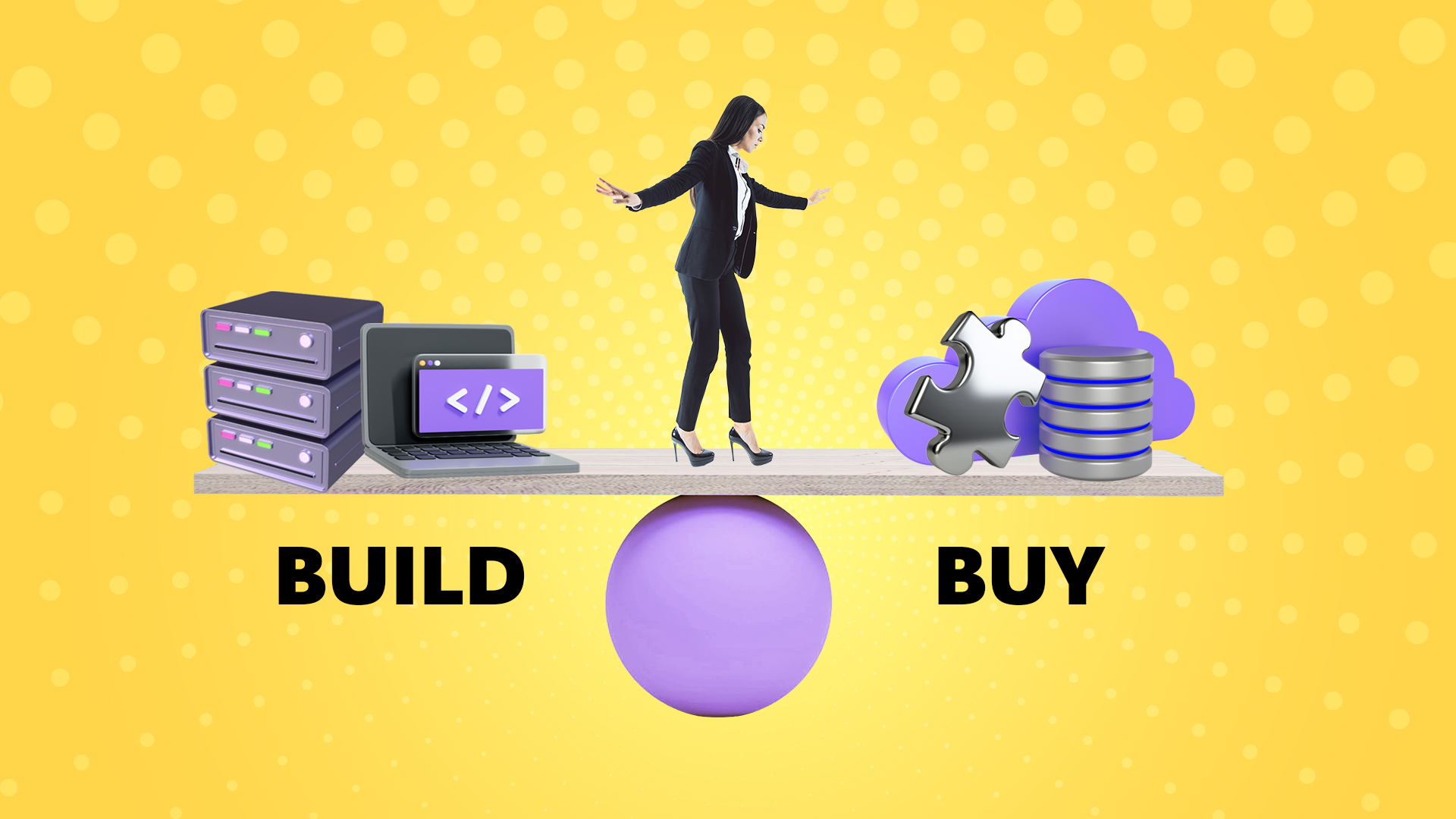
For years, CIOs treated the build vs. buy software debate like a coin toss. You either signed up for a multi-year, budget-draining custom engineering project, or you rented an off-the-shelf SaaS tool and forced your team to live with its quirks.
That binary choice is dead. Worse, sticking to it can easily inflate your technology costs by two to five times over a five-year stretch.
The SaaS Trap: Cheap Upfront, Brutal at Scale
Buying Software-as-a-Service (SaaS) makes complete sense for commodity workflows. Nobody needs to build a proprietary payroll system or an expense tracker from scratch. SaaS gets you live in weeks, not years.
However, the “predictable” subscription model hides a steep financial curve. Initial per-seat pricing rarely reflects your real total cost of ownership (TCO). Over five years, true SaaS costs typically run three to five times higher than the original vendor quote—and often exceed equivalent custom builds by 72%.
Where does the money actually go?
The 80/20 Customization Tax: Mid-sized enterprises spend roughly $250,000 a year paying consultants to bend rigid SaaS tools around their real-world operations. Look at Lidl’s infamous €500 million SAP disaster: trying to force a standard system to match unique inventory pricing tanked a seven-year rollout.
Renewal Lock-In: Once your data is deeply embedded, vendor leverage skyrockets. Annual renewal hikes of 10% to 20% are now routine.
The Integration Tax: Middleware and iPaaS subscriptions tack on another 20% or more just to keep siloed apps talking to each other.
The Custom Build Reality: Owning Your Edge (and Your Debt)
When a workflow is your competitive advantage, buying off-the-shelf erases what makes you different. Custom software development gives you total control over your roadmap, zero per-seat scaling penalties, and an average five-year ROI of 55% (compared to 42% for SaaS).
Still, building from scratch isn’t a free pass. Unmanaged technical debt silently eats up to 40% of enterprise IT budgets. And while AI coding assistants feel like a shortcut, controlled studies show they can actually slow experienced developers down by 19% on complex repositories due to bloated pull requests and subtle logic flaws. If you build, you must reserve 20% to 30% of your engineering capacity strictly for refactoring and perfective maintenance.
The Third Path: Composable Architecture
Smart enterprises aren’t choosing between pure SaaS and pure custom anymore. They use a “buy and extend” composable architecture: buy for commodity, build for differentiation.
With 70% of new enterprise apps now using low-code platforms, you can keep a stable back-office core while building custom microservices and frontends on top. Use Kissflow to let department heads automate everyday approvals in hours, and pair Microsoft Power Apps, Azure, and custom .NET or Angular builds for heavy-duty data orchestration and customer-facing IP.
Make the Right Call with ClinkIT Solutions
Don’t let vendor lock-in or scope creep dictate your roadmap. As a multi-time Microsoft Gold Partner and bespoke software leader, ClinkIT Solutions helps global enterprises audit their stack, calculate real TCO, and engineer scalable hybrid architectures across Azure, Power Apps, Kissflow, and custom code.
Ready to build what sets you apart? Connect with ClinkIT Solutions today to map your next technology investment.
Let’s build smarter campaigns together. Reach out to our team today.
Whether you’re starting from scratch or optimizing what you already have, we’ll help you turn great ideas into powerful, high-performing digital experiences.
Clink With Us!