Finding the right integration path for your SaaS is the most critical decision you can make right now, because there’s a quiet shift happening in the industry, and it’s not just about adding AI.
It’s about where AI sits in your product.
Some companies are rebuilding everything around it. Others are layering it in carefully, almost cautiously. And somewhere in between, a lot of teams are… honestly, just trying to figure out what makes sense.
If you’re building or evolving a SaaS product today, you’re likely facing this exact question:
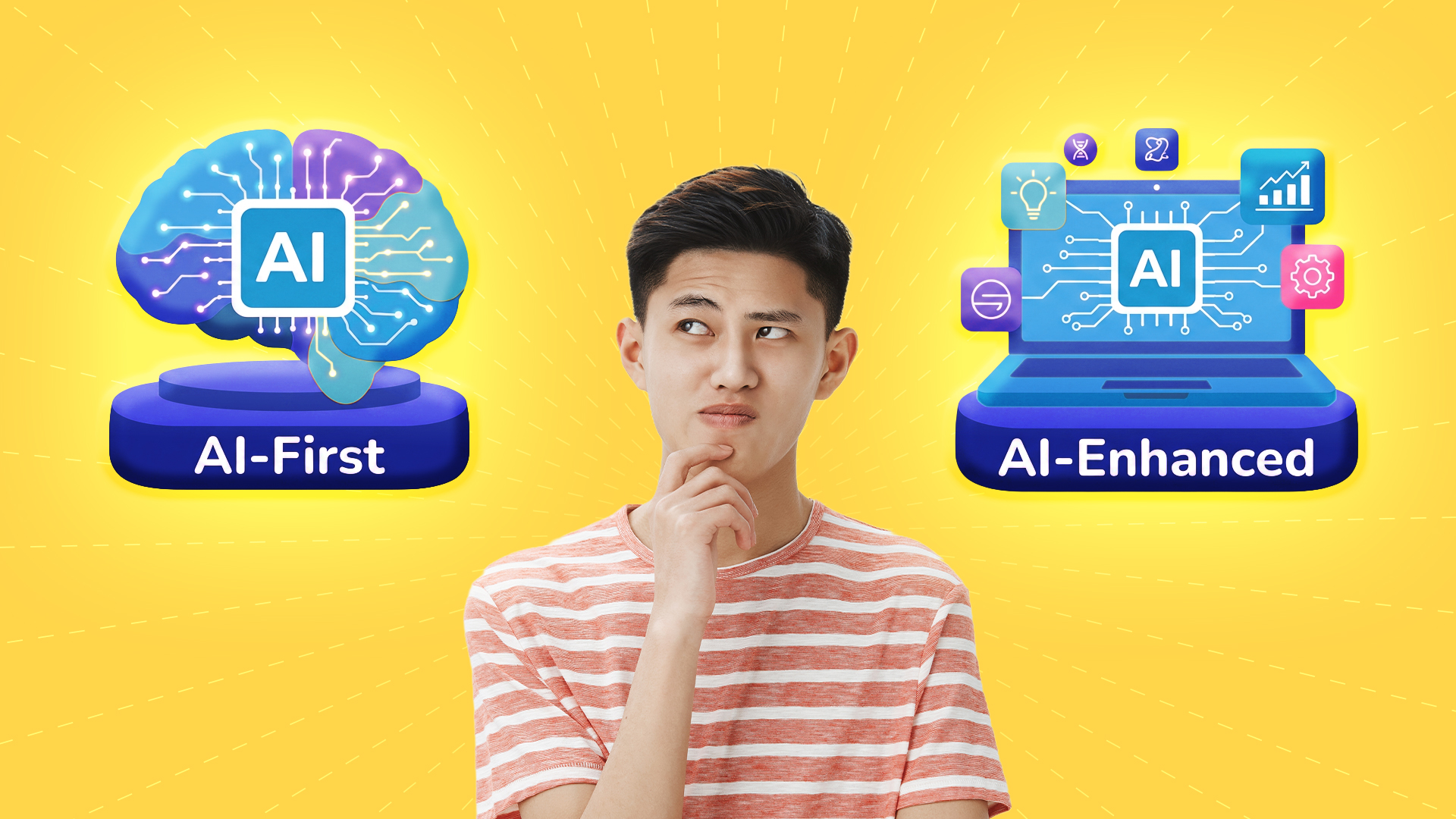
Do we go AI-first or AI-enhanced?
The answer isn’t as obvious as it sounds.
What “AI-First” and “AI-Enhanced” Actually Mean
Let’s strip away the buzzwords for a second.
An AI-first SaaS product is built around intelligence from day one. Without AI, the product doesn’t really work, or loses most of its value. Think tools like ChatGPT. The AI isn’t a feature. It is the product.
An AI-enhanced SaaS product, on the other hand, already has a working core. AI simply makes it better with faster workflows, smarter insights, cleaner automation. Remove the AI, and the product still functions. It just becomes… less powerful.
That difference sounds simple, but it changes everything from architecture to costs to time-to-market.
The Temptation to Go AI-First (And Why It’s Not Always Smart)
Let’s be honest. AI-first sounds more exciting.
It feels bold. Innovative. Future-proof.
And in some cases, it absolutely is.
If your product relies on:
- Large-scale data interpretation
- Predictive insights
- Automation that replaces human decision-making
…then AI-first isn’t just an option. It’s the only logical path.
But here’s where teams get it wrong.
They assume AI-first = better product.
Not necessarily.
AI-first comes with real trade-offs:
- Longer development cycles
- Higher infrastructure costs (think model calls, GPUs, scaling)
- Heavy dependence on high-quality data
- More complex engineering and maintenance
If your product doesn’t need AI to deliver its core value, forcing an AI-first approach can slow you down—and burn resources fast.
Why AI-Enhanced Is Quietly Winning for Most SaaS
Now here’s the less glamorous truth.
Most successful SaaS companies today are taking the AI-enhanced route.
Not because it’s safer but because it’s practical.
Take HubSpot, for example. When they integrated AI into their platform, they didn’t rebuild their CRM from scratch. They layered intelligence on top—improving insights, automating tasks, and enhancing workflows users already understood.
That’s the key.
AI-enhanced products:
- Deliver faster ROI
- Require less architectural overhaul
- Let you test and iterate quickly
- Reduce risk while still adding real value
It’s not about doing less. It’s about doing it strategically.
The Middle Ground: Hybrid Evolution (What Most Teams Actually Do)
Here’s something you won’t hear enough:
You don’t have to choose once and stick with it forever.
Many SaaS platforms start AI-enhanced… then gradually evolve.
Look at Notion. It began as a standard productivity tool. Then came AI writing features. Now? It’s moving toward AI-driven workflows and autonomous systems.
That’s a natural progression:
- Add AI features
- Learn from user behavior
- Re-architect where it matters
- Move toward deeper AI integration
In other words:AI-enhanced today can become AI-first tomorrow.
So… How Do You Decide?
Instead of overthinking the labels, focus on a few grounded questions:
1. Does your product depend on AI to exist?
If yes → lean AI-first
If no → AI-enhanced is likely smarter
2. Do you have proprietary data?
AI-first needs strong, unique data to create defensibility.
No data advantage? AI-enhanced usually delivers better ROI.
3. How fast do you need to launch?
- AI-first → longer timelines
- AI-enhanced → faster iteration
4. What’s your risk tolerance?
AI-first is a bigger bet.
AI-enhanced lets you experiment without rewriting everything.
5. What are you actually trying to improve?
- Core product experience → AI-first may make sense
- Efficiency, automation, UX → AI-enhanced is often enough
Simple but surprisingly clarifying.
A Quick Reality Check on Costs
This part gets overlooked a lot.
Traditional SaaS scales beautifully; serve more users, and marginal costs stay low.
AI doesn’t work like that.
Every prompt, every generation, every inference… costs something.
That means:
- AI-first products often have usage-based cost structures
- Margins behave differently than traditional SaaS
- Optimization becomes a constant effort
AI-enhanced models, meanwhile, give you more control. You can limit usage, test features, and scale gradually.
Common Pitfalls (That Teams Don’t Talk About Enough)
A few patterns show up again and again:
1. Building AI features no one asked for
Cool ≠ useful. If it doesn’t solve a real problem, users won’t care.
2. Overengineering too early
Jumping straight into AI-first architecture without validating demand.
3. Ignoring data quality
Bad data → bad outputs. No amount of model tuning fixes that.
4. Underestimating cost at scale
What works in a demo can get expensive in production fast.
What This Means for Your SaaS Strategy
If you zoom out, the decision isn’t really about AI.
It’s about how your product creates value.
- If intelligence is the value → go AI-first
- If intelligence improves the value → go AI-enhanced
Most companies don’t need to reinvent their product overnight.
They just need to make it… smarter.
Where ClinkIT Solutions Comes In
This is exactly where teams tend to get stuck, not in ideas, but in execution.
At ClinkIT Solutions, the focus isn’t just on adding AI for the sake of it. It’s about aligning your product strategy, architecture, and business goals, so AI delivers measurable impact.
Whether you’re:
- Exploring your first AI feature
- Scaling an existing SaaS product
- Or considering a full AI-first rebuild
The right path isn’t always obvious, but it is definable.
And once you get that decision right, everything else becomes a lot clearer.
Let’s build smarter campaigns together. Reach out to our team today.
Whether you’re starting from scratch or optimizing what you already have, we’ll help you turn great ideas into powerful, high-performing digital experiences.