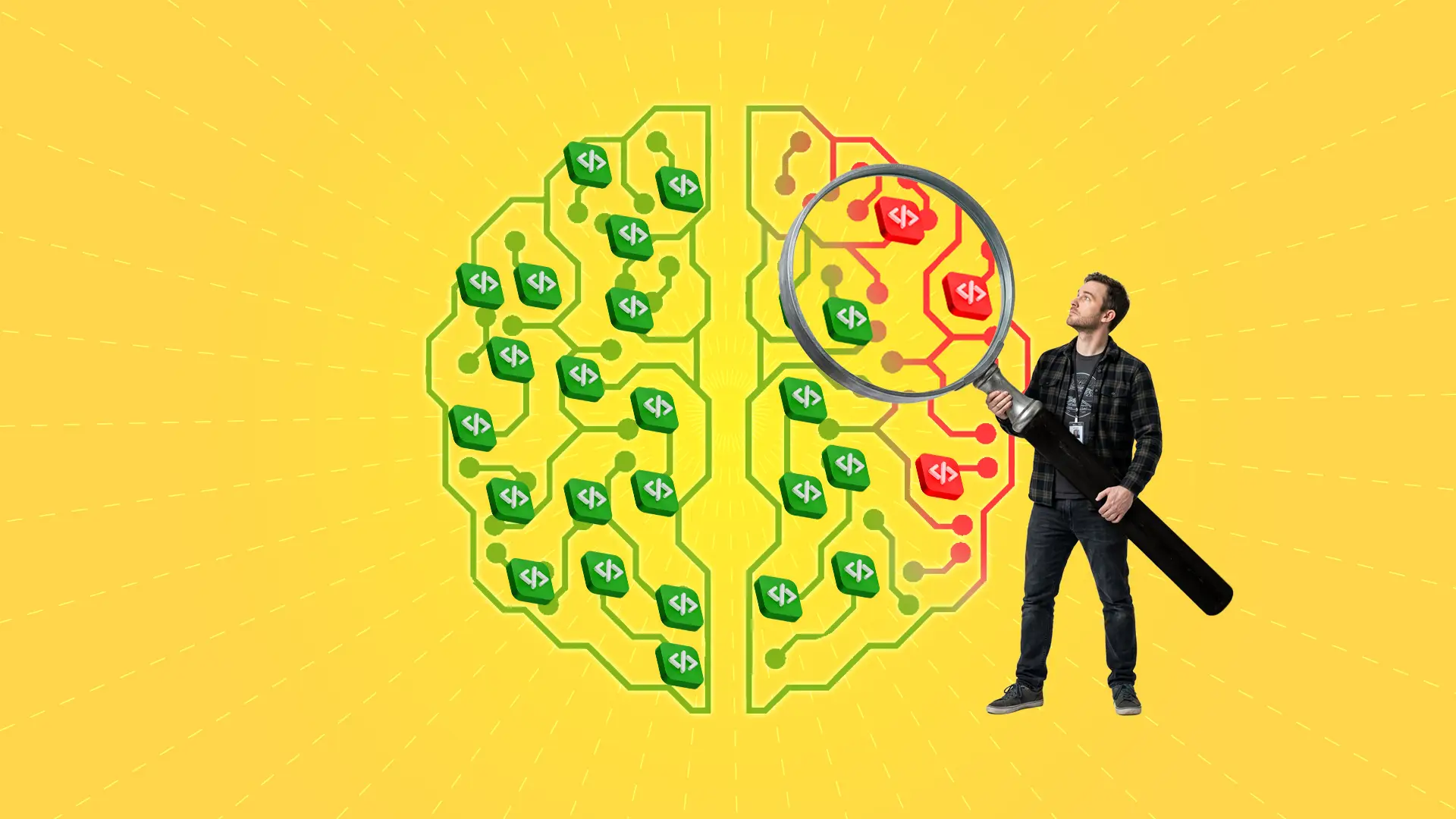
Software has never been easier to produce. It has rarely been harder to maintain.
That tension sits at the center of a problem most engineering leaders can feel but struggle to name. AI coding assistants have gone mainstream at a pace almost nothing in software history matches. Stack Overflow’s 2025 Developer Survey, which drew on more than 49,000 developers across 177 countries, found 84% now using or plan to use AI tools, up from 76% a year earlier. Google and Microsoft have each said AI now writes more than 20% of their new code.
Here’s the catch. All that generated code lands inside architectures that were never designed to absorb it this fast. The result is a quiet, compounding build-up of architectural technical debt. Not the kind that trips a failed build or a red test, but the kind that surfaces months later as systems that are slower to change, harder to reason about, and steadily more expensive to keep alive. It’s a silent crisis. And it grows in near-perfect proportion to how productive AI makes everyone feel.
What Architectural Technical Debt Really Is, and Why It Hides
Not all technical debt is equal. There are routine problems such as a messy function, missing test or unfinished task. These are annoying but local and usually cheap to fix.
Architectural technical debt is a different animal. It lives in the structure of the system itself: how components depend on one another, where data flows, which boundaries hold, and which quietly leak. Fixing it means touching many parts at once, which is exactly why it keeps getting deferred, and exactly why it compounds.
What makes it silent is that nothing breaks right away. Duplicated logic, bypassed patterns, and tangled dependencies, all of it runs perfectly well in production. Right up until the day someone needs to change it. Then a one-line feature request turns into a two-week archaeology dig.
AI-assisted engineering pours fuel on this particular fire. A coding assistant is brilliant at producing a plausible local solution and more or less blind to your system’s larger design intent. It doesn’t know your conventions, your service boundaries, or the abstraction your team spent last quarter building. So it does the fast thing. It generates fresh code, often a near-copy of something that already exists three directories over. In one 2025 practitioner survey, 51.6% of developers said they had watched AI tools bypass established architectural patterns, and 58.1% struggled to merge AI-generated code cleanly into existing, complex codebases. Spread that across a whole team shipping faster than ever, and the architecture erodes a little with every accepted suggestion.
The Data: Speed Up Front, Debt Out Back
The most-cited evidence comes from GitClear, which analyzed 211 million changed lines of code from 2020 to 2024. The trend is hard to wave away. In 2024, the frequency of duplicated code blocks of five or more lines jumped eightfold. And for the first time in GitClear’s records, copy-pasted lines outnumbered moved lines, the metric it uses as a stand-in for refactoring. Put plainly: before AI tools were common, developers chose to refactor rather than copy and paste by roughly two to one. Now they’re about five times likelier to paste.
Why does that matter? Because copy-paste is how architectural debt breeds. Every duplicated block is a change you’ll later make in five places instead of one. A bug you’ll fix four times. A pattern that drifts out of sync while nobody’s looking.
The human side of the ledger says the same thing. In Sonar’s 2025 State of Code survey of more than 1,100 developers, 96% said AI-generated code isn’t always functionally correct, yet only 48% said they always review it before committing. Stack Overflow’s 2025 data found trust in AI accuracy actually dropping, down to 33% from 43% the year before, with 66% of developers naming solutions that are almost right, but not quite as their single biggest frustration and 45% saying AI code takes longer to debug than they expect. More code shipped. Less of it trusted. Less of it reviewed in depth. That gap is where debt pools.
One fair caveat, worth stating plainly. GitClear and Sonar both sell code-quality and review tooling, so their framing naturally leans toward a problem they’re positioned to fix. But independent signals point the same direction. Google’s 2024 DORA report found that greater AI adoption nudged code quality up a modest 3.4% while cutting delivery stability by an estimated 7.2%. More speed, less steadiness.
Why This Is the Expensive Kind of Debt
Architectural debt doesn’t stay in its lane. It taxes everything built on top of it.
Start with delivery. As duplication and tangled dependencies spread, the cost of every future change climbs, because one edit now ripples through more places than anyone can hold in their head. Review slows too. Sonar found 38% of developers say reviewing AI-generated code takes more effort than reviewing a human’s, against 27% who say the opposite. So the productivity you banked at the keyboard quietly leaks back out in review, debugging, and rework. DX’s late-2025 analysis of more than 135,000 developers pegged the real time saving at around 3.6 hours a week. A genuine gain. Also a long way from the 10x the early hype sold, and the maintenance drag is a big part of why.
Then there’s the strategic cost, which is the one that should keep leaders up at night. Architectural debt is what stops a business from doing the next thing. You can’t cleanly lift a tangled system onto Azure. You can’t layer AI agents or real-time analytics onto a codebase whose own data flows can’t be trusted. The debt you took on to adopt AI faster becomes the exact thing blocking your next AI initiative. And for mid-market companies modernizing without a deep bench of senior architects, that ceiling arrives sooner and hits harder than it does for the tech giants generating the headlines.
How to Contain the Debt Without Slowing Down
The answer isn’t to stop using AI. The productivity is real, and teams that abandon these tools will fall behind the ones that learn to govern them. The answer is to put guardrails around the speed. A handful of shifts do most of the work.
Make architecture a gate, not an afterthought. Spell out the service boundaries, data contracts, and patterns you expect code to honor, and treat deviations as review-blocking, whoever or whatever wrote the code. AI follows the conventions it’s handed and ignores the ones it isn’t.
Close the review gap. The most alarming number above is that only 48% of developers always review AI code. Review of AI-generated changes can’t be optional, and it has to weigh structure and duplication, not just does it run. Static analysis and code-quality tooling earn their keep here, catching duplication and complexity before they merge.
Budget for refactoring on purpose. Since AI tilts everyone toward copy-paste over consolidation, the balance has to be restored deliberately. Reserve real capacity each cycle to fold duplicated logic back together, retire dead code, and tighten boundaries, before the debt compounds past the point of cheap repair.
Modernize the foundations instead of patching them. Where legacy architecture is already the bottleneck, bolting AI-generated features onto it just speeds up the decay. Targeted modernization, decoupling a monolith, standardizing APIs, moving the right workloads to the cloud, buys back the ability to move fast without breaking things.
Watch the system, not only the code. Observability and a standing architectural review catch drift while it’s still early and cheap, rather than at the next 2 a.m. outage.
Turning Architectural Debt Into an Advantage with ClinkIT Solutions
Most organizations aren’t short on AI tools or capable developers. What they’re short on is the architectural discipline and senior engineering capacity to absorb AI-era output without drowning in debt. That’s exactly the gap a seasoned partner fills.
ClinkIT Solutions brings custom software development, legacy modernization, cloud engineering, and proactive Managed Services 2.0 together under one accountable team, backed by more than 18 years in the industry, Multi-Gold Certified Microsoft Partner status, and recognition as the first Tencent Cloud reseller partner in the Philippines. Need to refactor an AI-bloated codebase? Re-architect a monolith for Azure? Stand up code-quality governance that holds across both human and AI contributors? Modernize legacy systems so they’re ready for AI instead of threatened by it? ClinkIT’s engineers build for the long maintenance horizon, not just the next sprint.
AI is only going to write more of your code. The real question is whether your architecture can carry the load. Talk to us to schedule a consultation with ClinkIT Solutions, and turn technical debt into a foundation for growth.
Let’s build smarter campaigns together. Reach out to our team today.
Whether you’re starting from scratch or optimizing what you already have, we’ll help you turn great ideas into powerful, high-performing digital experiences.
Clink With Us!