If you talk to ten marketers in 2025 about growth, you’ll hear the same debate framed in ten different ways.
“SEO is dead.”
“Paid ads are too expensive.”
“We just need better content.”
“We just need more leads.”
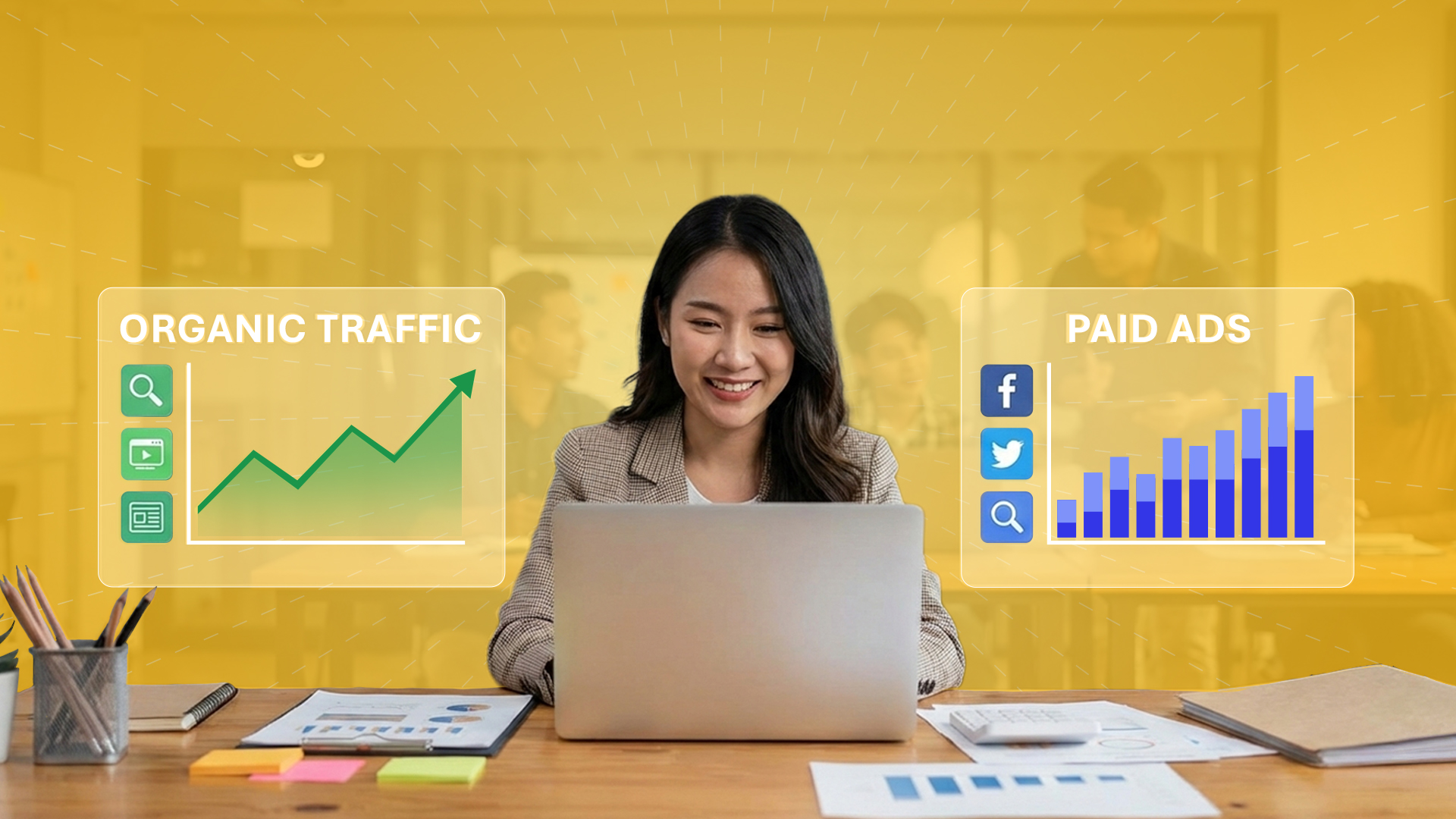
The truth is less dramatic and more practical. Organic Traffic vs. Paid Ads isn’t about choosing a winner—organic traffic and paid ads aren’t rivals anymore. They’re parts of the same engine. If you lean too hard on one, growth becomes fragile. If you balance them well, growth compounds.
For SaaS companies, tech providers, and B2B brands especially, the winners in 2025 aren’t choosing sides. Their building systems were organic trust and paid speed work together.
Let’s break down what that actually looks like.
Organic vs. Paid: What’s Really Different?
Organic marketing is everything you earn instead of buying. Blog posts, SEO, email newsletters, community building, social content. It’s slower, but it builds equity. Once it works, it keeps working.
Organic search results still receive the majority of clicks, especially for informational and research-driven queries.
Paid marketing is the opposite. You put money in and visibility comes out. Google Ads, LinkedIn, Meta, and programmatic display deliver immediate exposure. But the moment you stop paying, traffic stops too.
Here’s the simplest way to think about it:
- Organics are marathons.
- Paid is a sprint.
Organic search still drives the majority of clicks on Google. But those clicks don’t come overnight. It often takes three to nine months before SEO really moves the needle.
Paid search only captures a small percentage of total clicks, but it puts you on page one immediately. You can control who sees your message, when they see it, and how often.
Neither is “better.” They solve different problems.
Why the Old Silos Don’t Work Anymore
In the past, companies treated SEO and PPC like separate departments. Different teams. Different goals. Different metrics.
That doesn’t work anymore.
Customer acquisition costs have climbed sharply over the last few years. Competition is higher. Attention is fragmented. Privacy changes have made targeting harder.
When CAC goes up, efficiency matters more than volume.
The brands that are growing sustainably are doing three things at once:
- Using paid ads to validate demand and generate revenue now
- Using organic content to build trust and lower costs over time
- Letting each channel inform and improve the other
This feedback loop is where the real leverage is.
What Organic Growth Looks Like in 2025
SEO in 2025 is not about stuffing keywords into blog posts. It’s about being genuinely useful and clearly credible.
Google’s AI Overviews now answers many questions directly on the search results page. That means fewer clicks for shallow content and generic explanations.
What still wins?
Real experience. Clear expertise. Content that feels written by someone who’s actually done the work.
This is where E-E-A-T matters. Experience, expertise, authority, trust.
For tech and SaaS companies, that means:
- Engineers writing about real implementation decisions
- Strategists explaining why one approach worked and another failed
- Product teams breaking down trade-offs honestly
A developer comparing React, Vue, and Svelte from hands-on experience carries more weight than a recycled “top frameworks” list. Readers feel the difference. Search engines do too.
Technical SEO Still Matters More Than People Admit
Great content won’t perform if the site is slow, messy, or hard to crawl.
Sustainable organic growth depends on basics done well:
- Fast load times
- Mobile-first layouts
- Clean internal linking
- Clear page structure
- Schema markup where it makes sense
Featured snippets, FAQs, and structured content don’t just help SEO. They help users get answers faster, which improves trust.
For larger organizations, this discipline applies internally. Poorly structured systems and content libraries create the same problems inside the company that broken SEO creates outside it.
Paid Ads: Speed, Precision, and Reality
Paid advertising is still essential, especially in competitive markets.
If you’re launching a product, entering a new vertical, or targeting high-intent keywords, waiting months for organic rankings isn’t realistic.
Paid ads give you:
- Immediate visibility
- Tight audience targeting
- Clear performance data
In 2025, the most effective paid strategies are multi-channel. Google captures intent. LinkedIn reaches decision-makers. Bing offers cheaper enterprise reach. Paid social builds awareness and retargets warm users.
Programmatic ads add scale and efficiency, especially for awareness and mid-funnel exposure.
But paid ads only work well when the foundation is solid.
Why Retargeting Is Non-Negotiable
Very few people convert on the first visit. Especially in B2B.
Today buyers interact with brands across many touchpoints before making a decision. Blog posts, ads, webinars, emails, and social content. Often, all of them.
Retargeting connects those dots.
When someone reads your blog organically, then sees a relevant ad later; conversion rates go up. Costs go down. Familiarity builds.
This is where organic and paid truly intersect.
ROI, CAC, and the Money Question
At the end of the day, growth has to make financial sense.
SEO usually delivers the highest long-term ROI. Once content ranks, it keeps generating traffic without ongoing spending. But it takes time, which creates cash flow pressure.
PPC breaks even faster. Returns are usually lower, but revenue comes sooner. That revenue often funds long-term organic investment.
The smartest teams track blended CAC, not channel-specific vanity metrics.
They ask:
- What does it cost us to acquire a customer overall?
- How long until we break even?
- How does LTV compare to total acquisition spend?
When organic and paid work together, blended CAC almost always improves.
How Paid Data Makes SEO Smarter
Paid ads generate data fast. SEO takes time.
That’s an advantage.
Smart teams use PPC to:
- Identify keywords that actually convert
- Test headlines and messaging
- Discover long-tail search intent
If a keyword converts well in ads, it’s a strong candidate for a long-form organic page. If an ad headline drives high click-through rates, it often becomes a winning SEO title.
Paid traffic is research. SEO is the compounding investment.
How SEO Improves Paid Performance
The relationship goes both ways.
Well-optimized landing pages load faster, read better, and answer questions clearly. Google rewards that with higher Quality Scores.
Higher Quality Scores mean lower CPCs.
Strong organic rankings also reduce waste. If you already rank first for your brand name, you don’t need to overspend defending it with ads.
And organic visitors make excellent retargeting audiences. They already trust you enough to read your content.
Budgeting by Stage, Not Hype
There’s no universal “perfect” mix. It depends on where the company is.
Early-stage companies need speed and validation. Paid often dominates.
Growth-stage companies balance demand generation with brand building.
Mature companies invest heavily in organic authority and retention.
A simple rule that works well is the 70/20/10 approach:
- 70% on proven channels
- 20% on emerging tactics
- 10% on experiments
This keeps growth steady without stagnation.
Traffic Is Useless Without a Conversion Hub
All traffic leads somewhere. Or it should.
If your website is slow, confusing, or broken, organic and paid traffic both get wasted.
Before scaling acquisition, smart teams fix the foundation:
- Security and performance
- Analytics and funnel tracking
- Clear messaging and layouts
Wireframes, mockups, and prototypes aren’t “design fluff.” They prevent expensive mistakes and make every marketing dollar work harder.
Real Growth Comes From Balance
The best-performing brands in 2025 aren’t obsessed with one channel.
They show up everywhere their buyers look.
They build trust before they sell.
They use paid ads to accelerate what’s already working.
They use organic content to lower costs and deepen relationships.
Organic traffic gives you credibility.
Paid ads give you momentum.
Sustainable growth comes from knowing when to push and when to compound.
That’s the mix that lasts.
Let’s build smarter campaigns together. Reach out to our team today.
Whether you’re starting from scratch or optimizing what you already have, we’ll help you turn great ideas into powerful, high-performing digital experiences.