Enterprise AI is moving beyond standalone chat interfaces.
Some of the most valuable AI applications now operate inside business workflows—searching internal knowledge, analyzing documents, assisting support teams, processing data, interacting with APIs, and helping employees complete repetitive tasks.
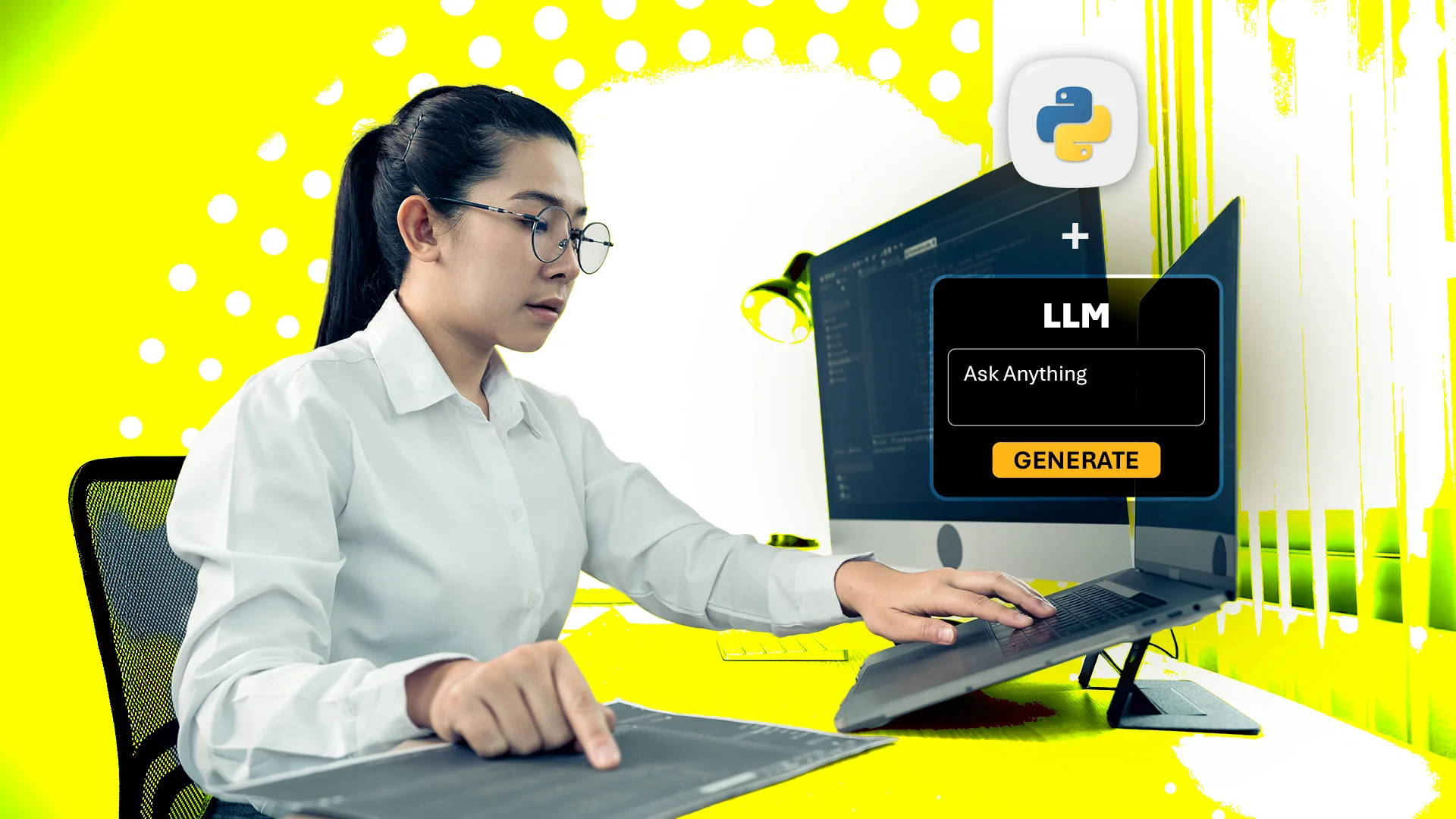
Python and large language models can provide the foundation for these systems, but production deployment requires much more than connecting an application to an AI API.
Organizations must consider data access, application architecture, integrations, security, model selection, monitoring, cost, and human oversight.
For businesses in the Philippines and international markets, these considerations determine whether an AI experiment becomes a useful business system or remains a proof of concept.
The Architectural Core: The Plan-Act-Verify Execution Loop
If you want an LLM-driven system to be reliable, you cannot rely on the foundation model to handle its own control logic. Instead, treat the model as a cognitive kernel housed inside a strict, predictable software framework governed by a deterministic Plan-Act-Verify execution loop.
Rather than blindly spitting out a generated response, a sophisticated system follows three distinct phases:
Plan: The architecture maps its execution path, validates database schemas, and flags missing parameters before touching data.
Act: The system programmatically executes localized code, queries vector databases, or triggers external APIs.
Verify: The system cross-references its own output against hard-coded business rules and source documentation, ensuring total mathematical and factual consistency before a human ever sees it.
Python is a natural backbone for these enterprise automation pipelines. Thanks to the explosion of machine learning, Python recently bypassed JavaScript as the most heavily utilized programming language on GitHub. This shift allows technical teams to build complex pipelines that bridge the gap between high-level language processing and legacy operational cores.
The broader ecosystem is expanding rapidly to support this. The global AI code tools market grew from $4.9 billion in 2024 to $7.65 billion in 2025, and is projected to touch $9.46 billion. Yet, a fascinating paradox exists: while 69% of developers using AI coding agents report massive productivity gains, 66% point to “almost right” AI-generated code as their primary daily frustration. This highlights exactly why programmatic verification layers are mandatory, not optional. Engineering firms like ClinkIT Solutions address these exact friction points by building flawlessly executed application developments that embed these custom Python pipelines straight into enterprise environments.
A Decision Blueprint for Agentic Frameworks
Choosing the right orchestration scaffolding matters. The framework you wrap around a model can alter operational performance by up to 30 percentage points on identical tasks. Princeton’s GAIA benchmark—which tests multi-step tool use, web browsing, and complex multimodal reasoning—places human baselines at 92%. In contrast, even the best-configured agentic systems achieve around 75%, proving that superior orchestration is the only way to close the performance gap.
Technical teams must evaluate the landscape of Python frameworks to select an architecture aligned with their specific operational and regulatory needs:
LangGraph: Built on a directed graph with conditional edges. Features stateful checkpointing with “time travel” debugging. Offers deterministic, auditable execution control, making it ideal for regulated environments. Completely model-agnostic.
CrewAI: Relies on role-based “crews” with sequential or hierarchical processes. Sequential task outputs are passed down the chain. Great for rapid prototyping and specialist team mapping, though it carries up to a 3x token overhead penalty. Completely model-agnostic.
Microsoft Agent Framework: Uses Azure-native agents and orchestration. Features dynamic memory persistence. Offers perfect alignment with Azure and C#/.NET corporate environments, and is optimized for Azure OpenAI.
Claude Agent SDK: Utilizes tool-use chains with sub-agents. Pluggable via the Model Context Protocol (MCP). Built for advanced tool use and safety-first extended cognitive paths. Optimized for Claude Sonnet/Opus.
Google ADK: Organized via hierarchical agent trees. Uses pluggable session-state backends. Features native cross-framework interoperability via the A2A protocol. Optimized for Gemini.
Pydantic-AI: Governed by strongly-typed operational loops. Uses ephemeral or database-mapped storage. Built for strict data validation and type safety, making it ideal for high-throughput pipelines. Completely model-agnostic.
LangGraph has quickly become the enterprise default for stateful, auditable workflows in highly regulated spaces like finance and healthcare, where every single decision path must be traceable. On the flip side, CrewAI offers the fastest path to stand up multi-agent prototypes in an afternoon, though its sequential structure can hit you with a hefty token overhead penalty. For enterprises anchored in the Microsoft ecosystem, the Microsoft Agent Framework offers a native bridge connecting modern Python microservices with core .NET infrastructure.
High-Impact Enterprise Use Cases
- Dynamic Commerce and Real-Time Inventory Optimization
Moving from static scripts to autonomous systems has completely transformed logistics. Modern retail platforms use cognitive action loops to digest messy, multi-source data feeds, including competitive pricing models, sudden weather shifts, and live customer sentiment across social networks. If automated technical scraping catches a regional stockout from a competitor, the agent automatically evaluates warehouse capacity, adjusts active digital storefront prices by an optimized margin, and programmatically triggers logistics APIs to reallocate physical inventory to high-demand fulfillment hubs.
- Healthcare Claims Triage and Compliance Pre-Screening
To safely navigate rigid HIPAA compliance boundaries, healthcare providers are deploying localized, privacy-compliant synthetic data pipelines. These custom Python applications pre-screen insurance claims to flag missing files, administrative coding errors, and policy anomalies before they are ever submitted to a clearinghouse. In active deployments, this pre-screening pipeline slashed insurance claim rejection rates by 34% within its first three months of operation.
- Technical SEO Automation and Answer Engine Optimization (AEO)
Traditional search optimization is undergoing a massive structural shift toward Answer Engine Optimization (AEO) and Generative Engine Optimization (GEO). Traditional search engine traffic is projected to experience a sharp 25% decline as users ditch standard queries for direct conversational answers. Securing accurate brand citations within ChatGPT and Google AI Overviews is suddenly critical to maintaining market visibility.
Python-driven automation is the primary tool used to scale this transition. Approximately 68% of enterprise SEO teams rely on Python to crawl websites, clean server log files, and execute on-page audits—driving a 10x increase in technical audit speeds and a 40% reduction in manual reporting times.
Web Crawling & Index Auditing relies on core libraries like BeautifulSoup, Scrapy, and Selenium. The execution mechanism automates the extraction of status codes, structured schemas, meta descriptions, and header tags. This prevents search crawling bottlenecks and verifies Core Web Vitals compliance.
Intent Clustering & Content Quality leverages NLTK, spaCy, and scikit-learn. It uses multi-dimensional N-gram analysis to group keywords by semantic intent and evaluates content against E-E-A-T standards. This builds the deep topical authority required to be cited as an authoritative source by LLMs.
Market Trend Analysis utilizes Pandas, Pytrends, and the SEMrush API. It processes multi-source keyword data in bulk with automated trend graph rendering via Google Colab. This allows marketing teams to instantly spot seasonal search drops and coordinate content calendars.
Financial Engineering: Token Mathematics and Total Cost of Ownership
Building high-impact Python applications requires a brutally realistic look at your total cost of ownership (TCO) and token consumption metrics. Upfront capital expenses and ongoing operational costs must be carefully modeled to guarantee a positive return on investment.
Discovery & Scoping runs between $15,000 and $50,000 upfront with no ongoing operational cost. The primary drivers are mapping project variables, defining success metrics, and structuring database schemas.
Data Remediation & Cleaning typically requires $20,000 to $150,000 in initial capital with no ongoing cost, driven by the need to resolve schema inconsistencies, duplicate records, and isolated data silos.
Legacy System Integration ranges from $20,000 to $100,000 upfront. This phase focuses on scoping undocumented APIs and integrating legacy mainframes like Oracle or COBOL cores.
Inference & Token Processing requires no upfront capital but incurs an ongoing operational expense of $2,000 to $25,000 per month. Costs are driven by recurring API token usage, with average query costs ranging from $0.002 to $0.15.
Governance & Security Compliance demands an ongoing investment of $40,000 to $120,000 per year, which covers constructing real-time policy filters, PII scrubbers, and regulatory audit logging pipelines.
Model Maintenance & Drift Retraining costs between $15,000 and $50,000 per operational cycle to periodically update local weights and adapt prompt configurations to avoid model drift.
The single biggest computational cost driver in long-running applications is the math behind multi-turn token compounding. Because standard LLMs do not maintain internal state memory between queries, the entire conversation history must be bundled, recompiled, and sent back to the model endpoint with every new turn.
To keep these compounding costs from spiraling out of control, mature enterprise architectures leverage two specific optimization paths:
RAG 2.0 Integration: By utilizing vector databases merged with dynamic knowledge graphs, developers can target and inject precise context segments instead of flooding the context window with raw documents. This reduces contextual token overhead by up to 20 times.
Hybrid OCR + LLM Pipelines: Running raw, massive files through high-capacity vision LLMs is incredibly expensive. Applying programmatic OCR layers to handle basic text extraction first, and using the LLM exclusively for semantic field mapping, reduces per-document token consumption by 60% to 70%.
Securing the Autonomous Frontier: Enterprise Governance and Guardrails
The moment Python agents are granted tool-use capabilities—giving them the power to read production databases, run local scripts, and hit external APIs—securing your operational boundaries becomes your highest priority. Runtime security solutions must be integrated directly into your preprocessing and postprocessing pipelines to halt prompt injections and shield sensitive customer data.
Modern setups employ a strict, dual-layered validation structure:
LLM Guard (Protect AI): This open-source toolkit provides 15 input scanners and 20 output scanners that run locally on CPU infrastructure. This delivers up to a 5x cost reduction compared to running heavy GPU-hosted safety classifiers. It automatically anonymizes PII in inputs, blocks jailbreaks, and sanitizes generated responses for secrets or broken URLs.
Bifrost AI Gateway: Written in Go, this high-performance control plane introduces a negligible 11 microseconds of overhead even at 5,000 requests per second—making gateway-layer policy enforcement highly viable for latency-sensitive systems. It enforces virtual key spending caps, rate limits, and model whitelists before requests ever reach an external provider. It also integrates with enterprise single sign-on (SSO) systems like Okta and Entra, and secures API credentials via HashiCorp Vault.
Lakera Guard and NVIDIA NeMo: Lakera Guard operates as a real-time cloud API firewall to prevent prompt injection without requiring code alterations, while NeMo Guardrails uses the specialized Colang DSL to enforce programmatic dialog flow states.
To comply with evolving GDPR-AI mandates and local data privacy frameworks, approximately 92% of highly secure enterprises now utilize a local scrubbing and anonymization layer to completely eliminate the risk of PII leakage to third-party endpoints.
Strategic Alignment: Build-versus-Buy Matrix
Deciding whether to build a custom Python architecture or deploy a pre-configured off-the-shelf SaaS solution requires a clear-eyed evaluation across five core enterprise criteria:
Workflow Flexibility: Off-the-shelf SaaS is limited to standardized productivity tasks like email drafting or basic document summarization. A custom Python architecture supports complex, non-linear multi-step agentic execution and autonomous tool use.
Legacy System Integration: SaaS solutions are generally restricted to modern, well-documented cloud APIs and standard enterprise platforms. Conversely, custom Python architectures operate natively inside complex legacy cores, database layers, SAP, Oracle, and COBOL mainframes.
Explainability & Governance: SaaS applications often present black-box model behavior with limited customization of internal safety logic. Custom architectures allow for fully bespoke, hard-coded validation rules and comprehensive, replayable step-by-step audit trails.
Data Residency & Security: Off-the-shelf options are third-party cloud managed, requiring external data egress and public network traffic. Custom Python setups support fully air-gapped, on-premise, or private virtual private cloud (VPC) isolated deployments.
Total Cost of Ownership (TCO): SaaS offers highly predictable per-seat or per-task licensing fees with lower upfront capital costs. Custom builds require higher upfront development capital, which is offset long-term by zero licensing lock-in and optimized, highly controlled consumption costs.
Building Production AI Systems with ClinkIT Solutions
Building, securing, and scaling these sophisticated cognitive systems requires deep engineering expertise that goes far beyond copying and pasting basic API calls. To avoid burying your organization in technical debt, hitting operational bottlenecks, and suffering from runaway cloud budgets, you need a seasoned technical integrator.
ClinkIT Solutions builds flawlessly executed IT services and applications designed specifically for the digital future. As a premier Managed Services Provider (MSP) and application development powerhouse, ClinkIT Solutions provides the specialized engineering depth required to transform Python and advanced LLMs into high-impact corporate assets.
Whether your goal is to integrate custom Python-driven agent cores into existing .NET, React, or Angular web environments, deploy secure cloud infrastructures on Microsoft Azure, or connect autonomous decision agents directly to Microsoft Dynamics Great Plains and Power BI dashboards, ClinkIT’s team of dedicated specialists ensures flawless execution at every phase. By anchoring cognitive architectures within secure, high-performance environments, ClinkIT Solutions empowers global businesses to automate complex workflows, maintain absolute data sovereignty, and secure a lasting competitive advantage.
Let’s build smarter campaigns together. Reach out to our team today.
Whether you’re starting from scratch or optimizing what you already have, we’ll help you turn great ideas into powerful, high-performing digital experiences.